
Norm Shock
A name for what you're feeling right now.

If you had to describe the feeling you’re feeling right now, what would you call it? You know the one. It comes on when there’s yet another news story that pops up and plants itself in a corner of your already busy mind. Another horrific act of violence, another bold-faced lie, documented, on record, verifiable by anyone with a phone. Another war that just materializes without any runway, without the scaffolding of reason.
Yes, that feeling. That “how-is-this-actually-happening-ness?” The catching of breath. The freezing. The lingering dismay that hangs out in the background even when you thought you’d processed it.
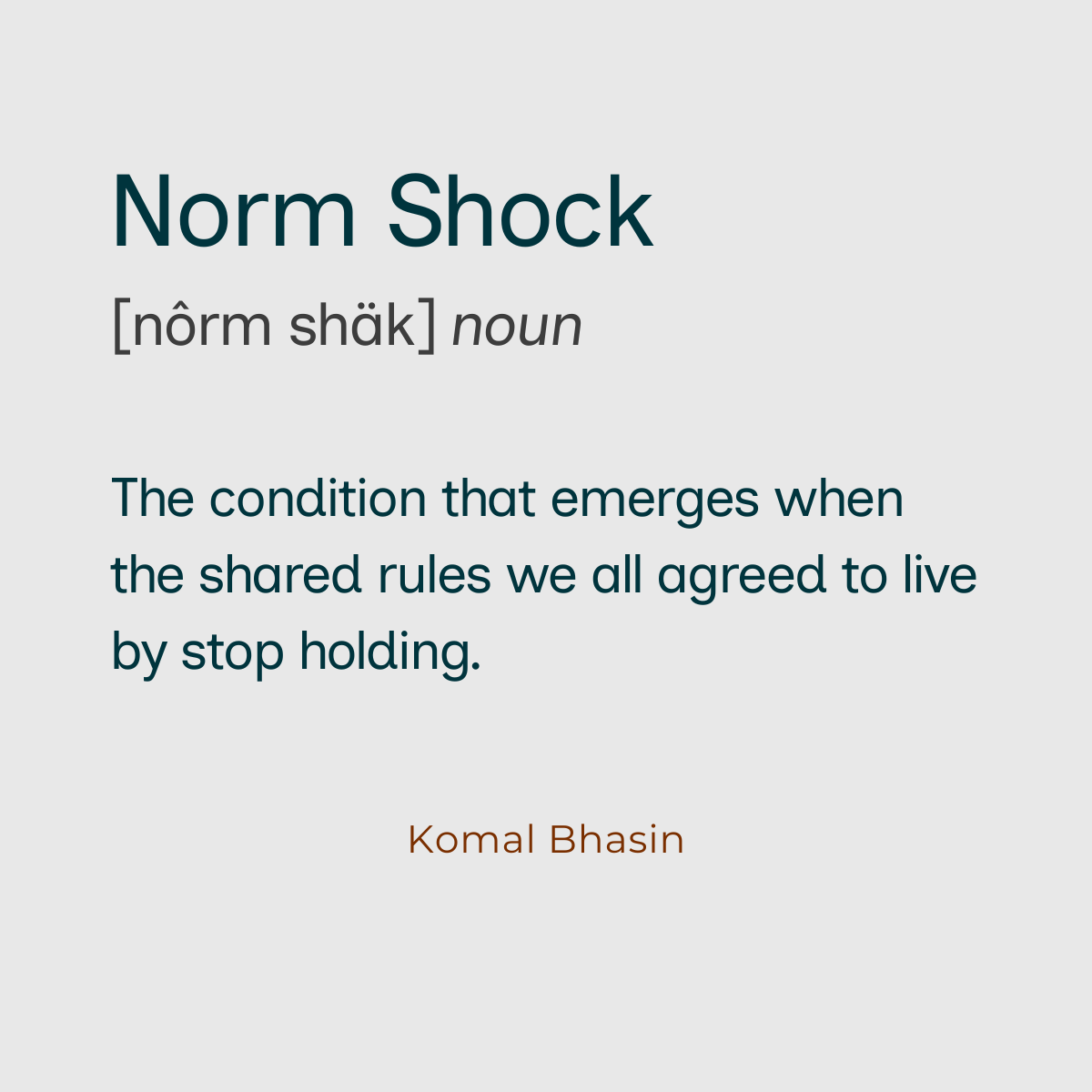
I’m calling it Norm Shock. What are you calling it?
I’m among people all day, in boardrooms, in hallways, in clinical sessions, in the kinds of conversations that happen when people finally drop the need to perform because the context is safe enough to reveal what’s going on under the surface. And what I’m seeing, across all the layers, is that people are feeling the collective fraying of this moment.
In my own attempt to sense-make, I kept thinking surely there’s already a term for this. Something that captures the social and political and cultural dimensions of what’s happening, and the felt, embodied experience of being thrown for a loop over and over. I looked at all sorts of theories and schools of thought and none quite described this felt sense. And then one day, I caught myself shaking my head and huffing quietly at yet another “WTF” piece of news and it hit me. I’m in shock that our norms have just up and disappeared. And that’s when it landed. That’s the term. Norm shock.
So what is norm shock, exactly?
Norms are not laws. They are the shared, mostly unspoken rules that make collective life legible. They are how cooperation gets codified by way of background agreements that tell us how to treat each other, what to expect, what is acceptable, where the lines are, and how to stay in them. We don’t think about them consciously. We don’t need to. They run quietly, organizing our sense of what is real, what is safe, and what kind of world we live in. We choose our spouses and friends and communities on the basis of these norms. We elect people to uphold and operationalize these norms, and while most of us know that this way of organizing is far from perfect, we live within these parameters because, well, they’re what we’ve got.
More than just social convention, we need norms to survive. Anthropologically speaking, humans are pretty weak alone. As animals, what makes us uniquely human is the capacity to cooperate and overcome our individual-level weaknesses. Cooperation is what got us here, what allowed us, 40,000 years ago, to outlast and outcompete far bigger and stronger species. We literally and actually need each other to survive. And norms are how that cooperation gets maintained, especially at mass scale. They are survival infrastructure.
When norms break down in ways that exceed what we’ve learned to absorb as a regular part of life, we register that. Consciously or not, the body and mind, what I’ll call our system, clock that something that was supposed to hold isn’t holding. When the breakdown is widespread and bigger than our system knows how to process, norm shock becomes the condition we live in. It is a state of experience from which we then process and make sense of everything else: the grief, the confusion, the numbing, the hypervigilance, the dismay.
How we respond to norm shock varies. For some it shows up as a recurring, returning unease that doesn’t fully resolve before the next thing hits. Layer upon layer of unresolved processing. People feel destabilized, like nothing holds anymore and that the world we live in has been an illusion. A loss of trust so pervasive that it brings an air of permanent suspicion towards anything that’s fed to us as truth. And there’s grief, at what we have come to know about the cruelty and callousness we are capable of, and the lack of possibility of recourse, a bitter pill for those who once believed that all is as it should be. For others, they have always known what has been laid bare, but it brings cold comfort. Just because people see things as they are now, it doesn’t mean that anything will change. What has all the consciousness really been for?
Confusion. I have never heard the word confused used more openly or more frequently than I do right now. People who are sharp, articulate, professionally accomplished are reaching for that word because nothing else fits. And underneath the confusion, a flooded inner dimension grasping to make sense of the world as it reveals itself.
My client, who I’ll call Nadia, tears up when I share what I think she’s experiencing. The tears come and I encourage her to let them. She tells me she has had five conversations today alone where someone brings up something happening in the world. She’s noticed over the last week that her shoulders are permanently up around her ears, and that she has to consciously drop them, every time, bracing for whatever’s coming next. Her life is already stressful and she’s always on the edge of burnout, but this feels different. She says plainly “I’m confused about what I’m feeling.” For months now she’s been caught in a cycle she can’t stop. She avoids the news deliberately and protectively and for a while it works. She feels a bit badly about intentionally sticking her head in the sand, but she doesn’t have a choice. Her kids are at the age when they really need her and she just doesn’t have the space to “properly care about the world.” She feels the collective heaviness but it mostly sits as a low hum under everything. But then one day someone says something in passing, a comment, a reference to yet another disturbing thing happening in the world, and she realizes just how out of touch she has become. Being out of touch doesn’t feel good either, it brings up guilt and self-critique. She picks up her phone and consumes everything she’s been avoiding, all at once. And it’s shocking. Every time. So, she puts the phone down and starts avoiding again. The cycle restarts, with no resolution.
What Nadia is experiencing isn’t a personal failing. It’s a completely coherent response to incoherence. Her nervous system is doing exactly what a nervous system does when the rules keep changing faster than it can process. She can’t find ground because the ground keeps moving. She can’t make sense of things because the shared framework for making sense of things is what’s destabilized.
She is not alone. And she is not misreading the moment.
We are all having our own experiences right now, but the collective frequency many of us are running on is a low dull buzz of not-okayness that spikes when an open nerve gets hit. A new piece of information. A fresh reminder that another norm is unraveling. The buzz persists in the background and the spikes come on unpredictably.
What’s important to understand is that all of these, including the numbing, the checking out, and even the grief, are appropriate responses to norm shock. They are not weakness. They are not overreaction. The nervous system, when overwhelmed, does what nervous systems do. It protects. Sometimes that looks like hypervigilance. Sometimes it looks like shutting down entirely. Sometimes the feelings flow freely. The full range of reactions fit.
This is what norm shock does. It doesn’t just unsettle us emotionally. It disrupts the apparatus we use to organize reality, the background operating system through which we determine what is happening, what it means, and where we stand. When that system is under strain, everything downstream is too. Our sense of safety. Our capacity to plan. Our trust in the people and institutions around us. Our ability to simply relax into a Tuesday.
Where do we go from here? Surely there must be a way through this moment and towards cohesion and a reestablishment of norms that will, at worst, bring things back into the fraught balance we all know, and, at best, land us in a better and more real place than what got us here. How do we get there?
I don’t have a tidy resolution to offer, and I have tried. It takes a lot as a witness to sit in support of another who is deeply struggling, and to share the struggle and not know where to go. Norm shock is real, it’s collective, and it isn’t going away quickly.
What I do know is that this is not the first time we have found ourselves inside a moment that exceeded our capacity to make sense of it alone. Our ancestors understood something about this that we would do well to remember. When things became too large to carry individually, they gathered and they named what was happening among them. They shared what they knew, what they feared, and what they had come to understand through experience and observation. They passed wisdom through story, through ritual, through collective practice, and through just being with each other.
Norm shock is more than a term. It’s a concept. It’s a frame of reference. The container that describes your range of feelings. A way of looking at a world that has lost its coherence. It is giving form to what seems formless, making the visible invisible.
This Substack is called Norm Shock because this is the territory we are in together, whether we chose it or not.
This is a space for those who can hold complexity without flattening it, those who bring what they understand about social systems and structures into the same room as what they understand about the body, the mind, and the spirit, and those who can see clearly just how fractured things are and still know that they will find their footing. A place to land, to think carefully, to name what is actually happening, and to make sense of it, slowly and imperfectly, in the way that we always have when the moment has exceeded what our systems were built to hold.
We won’t find our way out of this alone. This is a place where we meet to figure it out together.
Congrats on the new substack!! And thank you for starting this dialogue!
I love this definitive naming. It resonated with me so much even bringing up memories as far as childhood, not just at the big news things happening around the world but the societal norms and structures. It’s a question I often ask myself… “How is this normal?!”
I find myself observing the world’s latest normal with instead of screaming with shock WTF in my head which I was still doing in my twenties… rather its my shock and surprised has numbed to a gentle whisper of reminder to “the world is upside down.” This transformation in reaction has granted me clarity to ask and focus on, how can I create my smaller ecosystem of normal that works for me? How can I (and my smaller ecosystem I can create) exist in this upside down world? Then actively make the choice. Quietly.
The thing about living like this I’ve experienced is there is a lot of rejection and discomfort even if not proclaimed in the norm of activism, the action itself speaks so loud. When we’ve refused to conform into the normal there’s a lot of avoidance in being in the ecosystem you create for yourself.
It’s constant work like an internal homestead of cycles of growth… but in my experience its worth it.
Thank you for this, Komal!
It connects me to something Charles Eisenstein writes in his book The More Beautiful World Our Hearts Know Is Possible. His observation that crises are now arriving in such rapid succession that we don't have time to collectively process and restabilize from one before the next one lands. The social immune system, if we can call it that, never completes its response. We're perpetually mid-recovery.
What your term Norm Shock adds feels like the normative dimension. It's not just that we're overwhelmed by events. It's that the basic agreements about what reality is, what's acceptable, what we can count on, are being eroded faster than we can register the loss. Shock is the right word because shock is what happens when the body can't integrate what just occurred. Norm shock is what happens when culture can't.
Good to see you here on the 'Stack :)